
Jonah 2
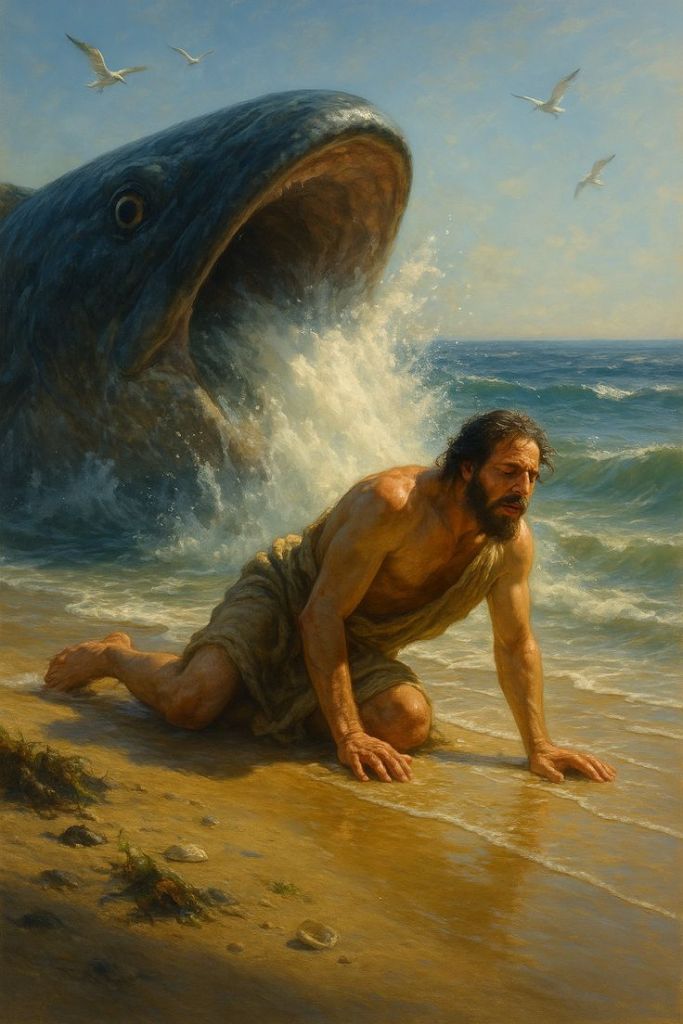
1 From inside the fish Jonah prayed to the Lord his God.
2 He said:
“In my distress I called to the Lord,
and he answered me.
From deep in the realm of the dead I called for help,
and you listened to my cry.
3 You hurled me into the depths,
into the very heart of the seas,
and the currents swirled about me;
all your waves and breakers
swept over me.
4 I said, ‘I have been banished
from your sight;
yet I will look again
toward your holy temple.’
5 The engulfing waters threatened me,
the deep surrounded me;
seaweed was wrapped around my head.
6 To the roots of the mountains I sank down;
the earth beneath barred me in forever.
But you, Lord my God,
brought my life up from the pit.
7 “When my life was ebbing away,
I remembered you, Lord,
and my prayer rose to you,
to your holy temple.
8 “Those who cling to worthless idols
turn away from God’s love for them.
9 But I, with shouts of grateful praise,
will sacrifice to you.
What I have vowed I will make good.
I will say, ‘Salvation comes from the Lord.’”
10 And the Lord commanded the fish, and it vomited Jonah onto dry land.
Jonah 2
Jonah spent three days and nights inside a fish, a pivotal event that Jesus referenced when speaking to the scribes and Pharisees about His own impending time in the heart of the earth. This audience would have been well-acquainted with Jonah’s story, particularly his desperate prayer to God during what felt like a near-death experience. Jonah described calling out from the depths, as he sank deeper into the sea, seemingly on the brink of death. Some scholars believe he reached the ocean floor before being swallowed. Yet, God remembered Jonah, heard his pleas, and granted him a second chance. After being released, Jonah found himself back at Joppa, the same place he had started, suggesting that God was giving him another opportunity to choose obedience, rather than returning him directly to Nineveh.

Jonah 3
Jonah Goes to Nineveh
1 Then the word of the Lord came to Jonah a second time: 2 “Go to the great city of Nineveh and proclaim to it the message I give you.”
3 Jonah obeyed the word of the Lord and went to Nineveh. Now Nineveh was a very large city; it took three days to go through it. 4 Jonah began by going a day’s journey into the city, proclaiming, “Forty more days and Nineveh will be overthrown.” 5 The Ninevites believed God. A fast was proclaimed, and all of them, from the greatest to the least, put on sackcloth.
6 When Jonah’s warning reached the king of Nineveh, he rose from his throne, took off his royal robes, covered himself with sackcloth and sat down in the dust. 7 This is the proclamation he issued in Nineveh:
“By the decree of the king and his nobles:
Do not let people or animals, herds or flocks, taste anything; do not let them eat or drink. 8 But let people and animals be covered with sackcloth. Let everyone call urgently on God. Let them give up their evil ways and their violence. 9 Who knows? God may yet relent and with compassion turn from his fierce anger so that we will not perish.”
10 When God saw what they did and how they turned from their evil ways, he relented and did not bring on them the destruction he had threatened.
Jonah 3 – Jonah Goes to Nineveh
When God approaches Jonah for a second time, He reiterates the original instructions, ensuring Jonah remembers his mission. This time, Jonah complies and travels to Nineveh, where he begins to deliver a message about their sins and the impending destruction if they do not repent. To Jonah’s astonishment, the people of Nineveh take his warning to heart; they fast, don sackcloth, and abandon their wicked ways.
Jonah 4
Jonah’s Anger at the Lord’s Compassion
But to Jonah this seemed very wrong, and he became angry. 2 He prayed to the Lord, “Isn’t this what I said, Lord, when I was still at home? That is what I tried to forestall by fleeing to Tarshish. I knew that you are a gracious and compassionate God, slow to anger and abounding in love, a God who relents from sending calamity. 3 Now, Lord, take away my life, for it is better for me to die than to live.”
4 But the Lord replied, “Is it right for you to be angry?”
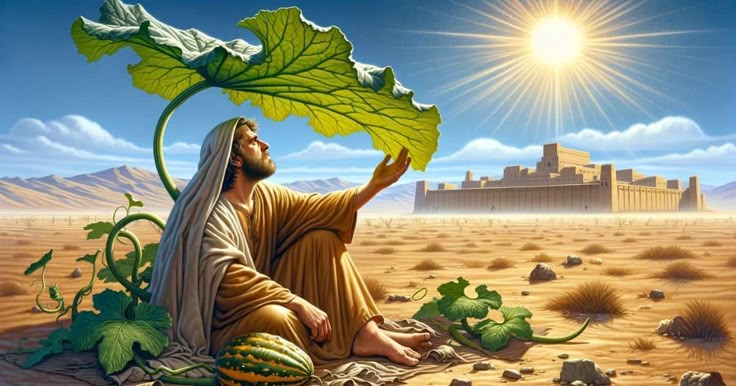
5 Jonah had gone out and sat down at a place east of the city. There he made himself a shelter, sat in its shade and waited to see what would happen to the city. 6 Then the Lord God provided a leafy plant and made it grow up over Jonah to give shade for his head to ease his discomfort, and Jonah was very happy about the plant. 7 But at dawn the next day God provided a worm, which chewed the plant so that it withered. 8 When the sun rose, God provided a scorching east wind, and the sun blazed on Jonah’s head so that he grew faint. He wanted to die, and said, “It would be better for me to die than to live.”
9 But God said to Jonah, “Is it right for you to be angry about the plant?”
“It is,” he said. “And I’m so angry I wish I were dead.”
10 But the Lord said, “You have been concerned about this plant, though you did not tend it or make it grow. It sprang up overnight and died overnight. 11 And should I not have concern for the great city of Nineveh, in which there are more than a hundred and twenty thousand people who cannot tell their right hand from their left—and also many animals?”
Jonah 4
Jonah’s Anger at the Lord’s Compassion
In the final chapter of Jonah, we witness his frustration over God’s mercy towards the repentant people of Nineveh. Jonah struggles to understand why these individuals, who had committed terrible acts, are spared from punishment. His anger leads him to remind God of His attributes, even wishing for death rather than witnessing the grace extended to the Ninevites. As Jonah sits in the shade provided by a plant, he waits to see Nineveh’s fate, but when the plant withers, he finds himself suffering under the harsh sun and again pleads for his life. Ultimately, God’s unwavering love prevails, as both Jonah and the Ninevites receive mercy they do not deserve. This narrative illustrates God’s patience and compassion, prompting us to reflect on how we treat others, especially our spouses. If God forgives us for our greater transgressions, we too should extend love and forgiveness to those closest to us, remembering the grace we’ve received.
Amos 1
1 The words of Amos, one of the shepherds of Tekoa—the vision he saw concerning Israel two years before the earthquake, when Uzziah was king of Judah and Jeroboam son of Jehoash was king of Israel.
2 He said:
“The Lord roars from Zion
and thunders from Jerusalem;
the pastures of the shepherds dry up,
and the top of Carmel withers.”
Judgment on Israel’s Neighbors
3 This is what the Lord says:
“For three sins of Damascus,
even for four, I will not relent.
Because she threshed Gilead
with sledges having iron teeth,
4 I will send fire on the house of Hazael
that will consume the fortresses of Ben-Hadad.
5 I will break down the gate of Damascus;
I will destroy the king who is in the Valley of Aven
and the one who holds the scepter in Beth Eden.
The people of Aram will go into exile to Kir,”
says the Lord.
6 This is what the Lord says:
“For three sins of Gaza,
even for four, I will not relent.
Because she took captive whole communities
and sold them to Edom,
7 I will send fire on the walls of Gaza
that will consume her fortresses.
8 I will destroy the king of Ashdod
and the one who holds the scepter in Ashkelon.
I will turn my hand against Ekron,
till the last of the Philistines are dead,”
says the Sovereign Lord.
9 This is what the Lord says:
“For three sins of Tyre,
even for four, I will not relent.
Because she sold whole communities of captives to Edom,
disregarding a treaty of brotherhood,
10 I will send fire on the walls of Tyre
that will consume her fortresses.”
11 This is what the Lord says:
“For three sins of Edom,
even for four, I will not relent.
Because he pursued his brother with a sword
and slaughtered the women of the land,
because his anger raged continually
and his fury flamed unchecked,
12 I will send fire on Teman
that will consume the fortresses of Bozrah.”
13 This is what the Lord says:
“For three sins of Ammon,
even for four, I will not relent.
Because he ripped open the pregnant women of Gilead
in order to extend his borders,
14 I will set fire to the walls of Rabbah
that will consume her fortresses
amid war cries on the day of battle,
amid violent winds on a stormy day.
15 Her king will go into exile,
he and his officials together,”
says the Lord.
Amos 1
During Amos’s time, Israel was governed by Jeroboam II and enjoyed a phase of peace and prosperity, yet spiritually, the nation had drifted away from God. In this backdrop, God appointed prophets such as Amos, Hosea, Jonah, and Isaiah to urge the people to repent. Amos, in particular, delivered compelling messages that highlighted the repercussions of the people’s sins while calling them to return to God. By this period, Israel had been split into two kingdoms for over 150 years: the southern kingdom of Judah, which had a mix of righteous and unrighteous kings, and the northern kingdom of Israel, which suffered under a series of corrupt rulers. Although Jeroboam II was politically and militarily adept, he remained ungodly. Historically, the northern kingdom faced threats from Syria until the rise of the Assyrian Empire around 800 B.C., which defeated Syria and allowed Israel to flourish under Jeroboam II, despite the moral decay emphasized in Amos’s prophecies.


 2 Lives, 1 Flesh
Leave a comment