
1 Peter 3
Wives, in the same way, submit yourselves to your own husbands so that, if any of them do not believe the word, they may be won over without words by the behavior of their wives, 2 when they see the purity and reverence of your lives. 3 Your beauty should not come from outward adornment, such as elaborate hairstyles and the wearing of gold jewelry or fine clothes. 4 Rather, it should be that of your inner self, the unfading beauty of a gentle and quiet spirit, which is of great worth in God’s sight. 5 For this is the way the holy women of the past who put their hope in God used to adorn themselves. They submitted themselves to their own husbands, 6 like Sarah, who obeyed Abraham and called him her lord. You are her daughters if you do what is right and do not give way to fear.
How do you win an unsaved spouse to the Lord? Whether it’s our spouse who is unsaved or other family members or friends, we need to know how to show the love of Christ to everyone. When Peter was writing this letter, he was writing it to persecuted Christians. He wanted them to have hope and to keep going with the faith. You will be entangled in a hostile environment; we see that in the government, our jobs, and our families. We are told to submit to our authority in all of these instances. We have an evangelist obligation to make Christ known to everyone around us. The most compelling testimony we can give is how we act, especially when times get tough. What is the obligation of a believing wife with an unbelieving husband? Peter offers 6 verses to wives and 1 verse to husbands. Some people think it is because women like more in-depth conversations; we like details; men, on the other hand, typically like things a little more cut and dry. However, when Peter wrote this, women were considered little more than slaves or animals. If the wife was a believer, she ran the risk of her husband divorcing her over her new faith. It could also be very embarrassing for a husband to have his wife follow Christ.
So how does a saved wife win her spouse to Christ? How does she fulfill her mission? First, he does not tell her to leave the unbeliever and find a good Christian man. No, Peter says that God’s blessing will be poured out on her, and the husband will get some of that blessing, too. He wants them to stay married and not divorce. Don’t rebel, and don’t leave the husband unless the husband wants out. He doesn’t tell her to preach to him; he also doesn’t tell the wife that she is equal to her husband and demands her rights. The husband is still the head of the household regardless of who is saved. If you want the maximum impact on your husband, be a model and submissive wife.
Wives have three duties: we are to be submissive to the head of the household, similar to how the military works and we are to fall in line in order of rank. They have been given a role of submission to the husband, who has headship over the household. A wife’s gentle, loving, and submissive behavior to her spouse will be her most incredible testimony to her husband, not the words that she says to him. The second duty is to faithfulness and respectful behavior, which means irreproachable conduct. The last duty is to modesty. Women are typically preoccupied with their outward appearance but don’t forget about the inward appearance. Since the dawn of time, women have been obsessed with jewelry, clothing, hair, and makeup. This was especially true in Peter’s day. But Peter tells them to focus on what they look like on the inside. Don’t spend time and money adorning your body; that is not how you will win him to Christ. But adorn yourself with a gentle and quiet spirit. This will not only be attractive to your spouse but is also pleasing to God.
Peter also names Sarah as one of the models of a Christian wife. When I think of Sarah, I think of her failure to wait on the Lord. I focus on her flaws—they were big and had enormous consequences for the rest of human history. But Peter says that we are to act like her.
If you follow the faith of Abraham and the submission of Sarah, you will be children of them. That was the ultimate blessing, to be called a son or daughter of Abraham and Sarah. So we will use her as our human role model, flaws and all.

7 Husbands, in the same way, be considerate as you live with your wives, and treat them with respect as the weaker partner and as heirs with you of the gracious gift of life, so that nothing will hinder your prayers.
Now, the husbands only get one verse. Some people think it’s because men only need a few words to get the point of the message. Typically, men like to be told to start and end here; they don’t need the details the ladies usually enjoy. Another reason for the one verse is that, in Peter’s day, finding a saved husband and an unsaved wife was less frequent. Typically, if a man was saved, his wife was obligated to follow his faith. If she didn’t, the husband was allowed to divorce her; heck, he was even allowed to kill her if he caught her cheating. In those days, husbands could be harsh and ruthless to their wives, which was normal. So, what Peter tells the husbands is a complete 180 from what society expects of them. Peter wants a Christian husband to look differently. He wants them to be considerate and sensitive to her needs and feelings. He was to maintain deep intimacy with her. Peter also says to respect her because she is weaker. But look closely at those words; he doesn’t say she is weak but weaker. Weaker than who, her husband, because we are all weak without Christ. She is weaker, but he is weak, too, physically and mentally. Also, remember that she is a fellow heir and a husband’s gift; without her, he would not be able to continue on his family lineage. She is also to be considered a friend to him, and if her husband does not treat her the way Peter outlines, his prayers will not be answered. So, if a husband is gentle, considerate, and sensitive to his wife’s needs, God is more inclined to listen and consider his prayers.

Suffering for Doing Good
8 Finally, all of you, be like-minded, be sympathetic, love one another, be compassionate and humble. 9 Do not repay evil with evil or insult with insult. On the contrary, repay evil with blessing, because to this you were called so that you may inherit a blessing. 10 For, “Whoever would love life and see good days must keep their tongue from evil and their lips from deceitful speech. 11 They must turn from evil and do good; they must seek peace and pursue it. 12 For the eyes of the Lord are on the righteous, and his ears are attentive to their prayer, but the face of the Lord is against those who do evil.”
What does it mean to love life and see good days? The assumption is everyone wants to have a good day and a good life. This love of life is not talking about the pleasures of this world, such as money, power, and beauty, but rather the love of life as God wants us to enjoy. King Solomon was one of the wealthiest people ever but was not happy. He said he hated life and everything was fleeting. Solomon had everything people desired, yet he still needed to be fulfilled. The highest suicide rate in our country is among people over the age of 60 when they realize all their efforts and strife have not led to happiness. Few people have good days, are fulfilled, and are happy. But as Christians, we can have goodness and fulfillment even when our situation is less than desirable. We want our days to be productive, fulfilling, meaningful, satisfying, etc. These are the kind of days that everyone wants, but how do you get them?
Peters tells them four ways to love life and get good days. He first tells us we need to have the right attitude. We will never be without problems or the things we desire, but if your attitude is correct, you will see the blessings of God. He tells us to live in harmony with everyone; that sets us apart from the rest of society. This is not easy, but it is essential. The church should be the peacemaker of the world. We are also to be sympathetic to one another, to suffer with someone. We should be known and ready to suffer with others. We are not to be indifferent or condemning to the rest of the world but tender-hearted. We are to love with a brotherly love, bringing peace and harmony to those around us. We do not start riots or revolutions; we welcome the hurting and comfort them in their time of need. Finally, we are to be kind-hearted. We are to be tender-hearted, compassionate, and forgiving. This is the most profound human emotion. God was the ultimate compassionate being; He sent His son to die for us. What God wants us to be are people different from the world, always pursuing peace, eager to love and serve, always tender-hearted, always humble, and never demanding. We can look to Jesus as our perfect example of what all of this looks like.
We can apply every single aspect of this to our marriage. We all want a happy marriage, but we can be guaranteed that in this life, we will have conflict and strife in our marriage. For some of us, those times are few and far between; for others, it is a daily occurrence. But Peter tells us not to seek revenge and to be careful of our words. Our spouse can hurt us in many ways in how he acts and says, but it is up to us how we respond to that. Remember that our job in this world is to seek peace, whether out in the world or in our own homes. If you seek peace with your spouse, you will find it. Lean on Jesus. (compassion) 11/20/24

13 Who is going to harm you if you are eager to do good? 14 But even if you should suffer for what is right, you are blessed. “Do not fear their threats; do not be frightened.”
Throughout this letter, Peter tells the Christians how to act in a hostile environment. We don’t get a lot of that kind of suffering in our present day in the United States, but in Peter’s day, being a Christian could be reason enough to have you killed. So, how do you act in a world that hates you? Peter reminds the people of those days when we were chosen people by God, but we are also foreigners and aliens of this world. We are to be in the world, not of the world. It’s a challenging balance to live, but we must also win people over to the Lord. No matter what age we live, we have many interactions with the people of this world, and we are to have cause for confidence and joy whether we live in a hostile or peaceful time.
As we confront this hostile world, we should be passionate about doing what is good. Even in a hostile world, people are slow to hurt those of us who are kind. It’s easy to come against those who cheat, kill and destroy. Peter tells us to live our lives so the people of this world have to dig deep to persecute us. But Peter tells us that even if we do, we might still be persecuted, but if we are, we are to be considered blessed. I mean, after all, they did kill Jesus, and He was perfect, so it is not unreasonable for us to think that our lives will be void of harm. Just as Jesus was persecuted, we will most likely be too, but we know that this happens to us for our refinement, to make us more pure in our faith. Peter tells us not to fear the people who persecute us but rather fear God. He can do much more to us than any mere man. They can take your life, but only God has control over your soul. No matter what comes against you, your love and adoration should always be to the Lord first, and I will be loyal to Him no matter what. We are to please God with our loyal submission.
15 But in your hearts revere Christ as Lord. Always be prepared to give an answer to everyone who asks you to give the reason for the hope that you have. But do this with gentleness and respect.
We should also always be ready to make a defense for why our hope is in the Lord our God rather than what is going on in the world, whether we are being persecuted in a formal trial in front of a judge or just by a stranger on the street. We should be able to give a rational defense as to why you are a Christian and why your hope is not in this world. We should be able to explain to people with good evidence and facts and be courageous enough to share our faith. Peter also tells us that we need to have a clear conscience so that we experience no pain or anxiety when we are criticized. If we are accused of something true and we have been living in an ungodly way, then we are not spared from the pain, anxiety, and punishment we will endure. What does your conscience say to you? Are you living right, living in loyal submission, living your life for Christ? If you are, then the thing you are being slandered for will hold no weight. The people of this world love to slander the people of faith. If they can prove such things, it makes them feel more righteous. But Peter tells us don’t give them a reason to slander you.
16 Keeping a clear conscience so that those who speak maliciously against your good behavior in Christ may be ashamed of their slander. 17 For it is better, if it is God’s will, to suffer for doing good than for doing evil.
We have options; we can suffer for doing what is right or wrong. If we suffer for doing what is right, we only have to face the consequences from the people of this world, but if we do wrong things, we will get our punishment from God. Either way, God will use that suffering to mold and shape us. We can use that good behavior to make us better models of Christ, or He can use our lousy behavior for our well-deserved punishment. There will always be pressure to compromise how you live. Compromise will lead you down a dark and troubled path.

18 For Christ also suffered once for sins, the righteous for the unrighteous, to bring you to God. He was put to death in the body but made alive in the Spirit. 19 After being made alive, he went and made a proclamation to the imprisoned spirits—
Peter continually points us to Christ as our perfect example of how we are to conduct ourselves. We will suffer in the flesh; Christ is our model, and if He suffers, we will, too. He wants us to respond the way Christ did to our suffering, but he wants us to have victory and triumph in the same way. We not only need to have the right attitude when suffering, but we must also keep our eyes on the long game, meaning there will be some triumph. It might be on Earth, or it might be in Heaven; either way, we are still victorious. Even though Jesus suffered here on Earth and was crucified for doing what was right because of His death on the cross, now He has victory over death. In the darkest hours of Christ dying on the cross, Heaven was getting the victory. Jesus died so that we could be brought to God. Peter reminds us that we can count on suffering in the world because we are not perfect, but Christ was, and He suffered and paid the ultimate price. He endured the worst suffering, something many of us will never know. Most of us will not be put to death for following God. Peter also points out that Christ died once for the forgiveness of sin. The Jewish people were used to making blood sacrifices year after year. It needed to be done continually, but Christ’s death was a one-time event that covers all sins from the beginning of time throughout eternity. The death of Jesus Christ was ultimate, on behalf of sins, unique, comprehensive, vicarious, and purposeful. He died on purpose for us so we could have a relationship with God. This is why the veil was torn in two: because we no longer needed a high priest to speak on our behalf to God, and we now have direct communication with God. With that being said, one has to wonder why the Catholic church still practices that you must confess your sins to a priest in order to be forgiven. According to Peter, inspired by the Holy Spirit is 100% false teaching. We have direct access to God through Jesus, whose blood poured out for us. By accepting Jesus as our Lord and Savior, Jesus then introduces us to God, and from then on, we have ultimate and unlimited access to God. The death of Jesus not only opened this relationship for us, but He also conquered the spiritual realm. Jesus, during His 3-day death, went and preached a sermon in the spiritual realm. Jesus’ death on the outside looked like a total failure. Our hero died, but He didn’t just die and stay dead; he is still alive. We now have a relationship with God, and all of the spiritual world heard His proclamation.
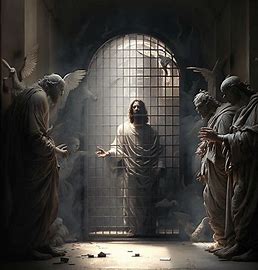
20 to those who were disobedient long ago when God waited patiently in the days of Noah while the Ark was being built. In it, only a few people, eight in all, were saved through water, 21 this water symbolizes baptism that now saves you also—not the removal of dirt from the body but the pledge of a clear conscience toward God. It saves you by the resurrection of Jesus Christ, 22, who has gone into Heaven and is at God’s right hand—with angels, authorities and powers in submission to him.
Peter uses Noah as an analogy to the triumphant salvation Christ has provided. Noah was a preacher and did so for 120 years while he built the Ark. During all those years of preaching, only eight people listened to his words, and only eight people were saved. The rest of the population would rather continue in their sin than repent and turn towards God, and because of that, they lost their lives when the flood came. Only eight people on the face of the Earth believed in God and were willing to follow His ways. But for those eight people, the Ark was their salvation. The Ark carried them from a world of sin into a brand new life by passing through judgment. They still had to go through it, but they were untouched and safe in the Ark. Peter now links the Ark to the believer. The believer is saved through Jesus, and we are not subject to God’s judgment. Just like Noah was placed in the Ark for safety, we have also been placed in a type of Ark that will save us. The judgment of God came upon Jesus, but Jesus is our Ark of safety because of His death and resurrection. Once the flood was over, Noah and his family walked out into a new life in a new world, just as we will have a new life in a new world in Heaven.
Then, we look at the glorious final note of triumph. Jesus went to Heaven and was at the right hand of God. Throughout the Old Testament and into the New and throughout eternity, the right hand of God is always seen as the seat of the highest preeminence. The right hand of God is the place of strength. The right hand of God is the place of authority. It simply says that when Jesus had accomplished His work at the cross, He was exalted to the right hand of God, the place of prominence, honor, majesty, authority, and power. You see, because He was willing to submit Himself, God highly exalted Him, and it was through His suffering that He triumphed, and He now ranks above all beings. And now all angels and authorities and powers had been subjected to Him.


 2 Lives, 1 Flesh
Leave a comment